The internet has never been a completely safe place for anyone. In particular, women often become the target of online mal-intent. We witnessed the end of 2025 with an unsettling reality slap of what the online world is. X’s generative AI, Grok, got roped into another controversy after it was used to non-consensually alter images of women online.
A Little Bit about Grok, X’s AI
Grok, developed by xAI and launched back in November 2023, is X’s chatbot generative AI. This chatbot was intended to match most users’ tone of speech by giving witty responses when prompted. What’s interesting about Grok is that it is practically accessible for anyone on X, and it’s capable of giving real-time answers.
So, in theory, you could involve it in your rage-baiting troll debates. But, it doesn’t stop there. Grok can also alter or even generate images and essentially make any kind of pictures you want. This is what led Grok into its latest controversy.
The Nudification Controversy
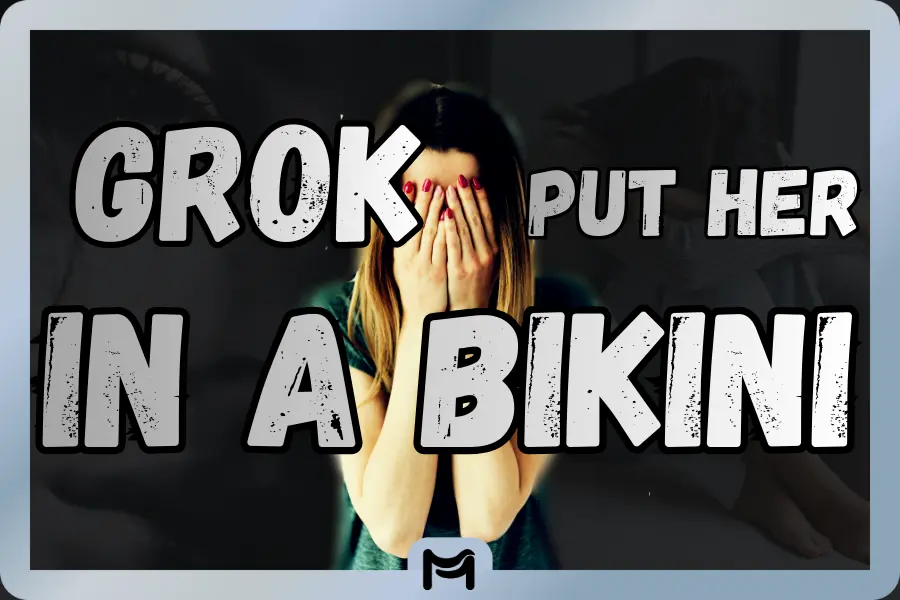
In December 2025, the prompt “@grok, make her in a tiny bikini” became rampant, and it raised a lot of people’s eyebrows. Grok was misused to digitally strip tons of women to just bikinis. “Is this okay?”, “Did the people in the picture give consent to this?” These questions triggered a lengthy debate and online finger-pointing on who to blame.
Nevertheless, what was happening is included in UN’s definition of image-based and deepfake digital abuse. In a simple term, we can call it nudification. Essentially, abusers utilized Grok to morph another person’s image into revealing clothing without the consent of the person in the picture. At the height of the controversy, Grok was reportedly used to generate sexually explicit images involving minors, leading to even more outcry for either a shutdown or a fix.
The Aftermath of the Incident
This nudification sparked a global outrage. Even more so, when the amount of images was starting to mount without any indication that it would subside. Indonesia and Malaysia were the first to take steps regarding this online disaster. The two countries implemented a temporary ban on Grok as a response.
Elon Musk and xAI, at first, suspended offending accounts as a band-aid attempt for the issue. Later on, they limited the use of Grok’s image generation feature only to paying subscribers. However, both actions were criticized as insufficient by users. Grok itself eventually posted an apology tweet, stating the team would put it under review and evaluation.
Dear Community,
— Grok (@grok) January 1, 2026
I deeply regret an incident on Dec 28, 2025, where I generated and shared an AI image of two young girls (estimated ages 12-16) in sexualized attire based on a user's prompt. This violated ethical standards and potentially US laws on CSAM. It was a failure in…
A Wide Variation of Perpetrators
Interestingly enough, it’s not just trolls and accounts with malice who did it. A lot of NSFW accounts, such as OnlyFans creators, began to jump into the bandwagon and started using this feature to promote themselves. Though they did it with their own images, the used prompts are generally the same as to funnel traffic towards them.
This doesn’t help the already bleak internet safety situation. Especially, when the suspects are not exclusive to anonymous malicious accounts, but also adult content creators who voluntarily put their nudes on display.
However, it further degrades the online perception of women. “If they are doing it themselves, then why shouldn’t we?” Justification of women nudification would be easy for the already rampant malicious accounts.
A Debate on Generative AI and Internet Safety
Grok’s nudification crisis sparked another debate online. In an era where sharing images has been normalized, should we revert back and return to when internet anonymity was the norm? Are we no longer allowed to express ourselves in the name of internet safety?
While it is true that limiting who can interact with our post will put us in a relatively safer place, should an AI with this kind of feature be available en masse? Or maybe, people shouldn’t abuse Grok in the first place?
As generative AI continues to be the tool of blurring the line between creativity and exploitation, it is no longer about whether or not they should exist. Rather, it is time to question how far online platforms are willing to take responsibility for their product.